
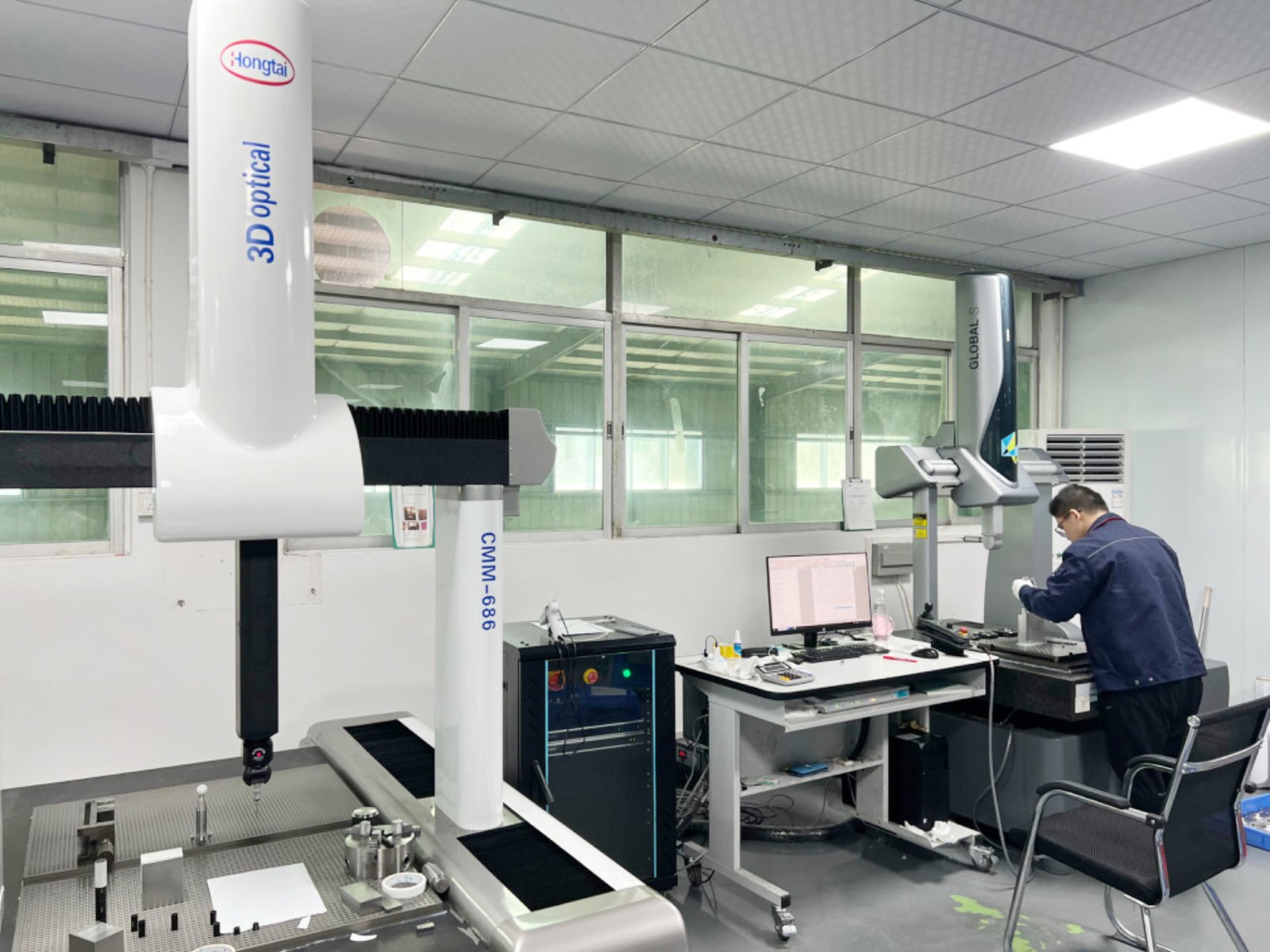
"Should this part be machined in China?" is really three questions stacked on top of each other. The first is whether the part should be machined at all rather than cast, forged, molded, or printed. The second is which material the part must be, because the material decides which processes are even possible. The third is where the machining should happen, because the geography decides the landed cost, the freight leg, and the correction loop. Most buyers jump to the third question — the China question — before answering the first two, and pay for the shortcut in wrong tooling, wrong tolerances, or a freight bill that erases the price advantage. This guide works through all three layers in order.
Why does the decision have to run in layers, not in one step?
The three layers are decided by different evidence. The process layer is decided by geometry, volume, and tolerance: a part with a blind internal cavity cannot be machined; a part at five thousand units a year rarely justifies a die; a sealing face at ±0.003 mm is machined no matter how the blank is made. The material layer is decided by the service environment: corrosion, load, temperature, weight, and regulatory demands each rule out whole families of processes. The geography layer is decided by economics and logistics: landed cost, freight time, iteration speed, and the cost of a failed lot. Decide the process and material first, and the geography question becomes precise; decide geography first, and you are choosing a supplier for a part that may belong to a different process entirely.
There is a practical reason to respect the order as well as an analytical one. A process decision is long-lived — once a part is tooled for casting or molding, the tool locks the process in for the life of the program, and the sourcing decision follows the process. A geography decision is comparatively easy to revisit: the same machined part can move between a local shop and a China supplier as volumes, deadlines, and freight prices change. Lock the process and the material with care, and keep the geography decision deliberately flexible, because it is the layer you are most likely to revisit.
Which parts should be machined at all, and which belong to forming or molding?
Machining's strengths define its territory. It starts from wrought bar, plate, or billet — material with full wrought strength and a certificate naming its grade and heat — and it defines geometry with a cutting tool, which is why it holds tolerances no forming process can match: ±0.003 mm in milling and turning, ±0.002 mm in precision grinding, with capability at Cpk 1.67 or higher on key characteristics and Cpk ≥ 1.33 on general characteristics. Capability is reported per characteristic: every report names the feature, its tolerance band, the sample size, the sigma method, and the study window. It carries almost no tooling cost, so it serves quantities from one piece to thousands without a fixed investment. Its limits are equally clear: it cannot reach a blind internal cavity, it wastes material where a net-shape process would not, and its per-part cost barely falls with volume.
Casting wins where those limits bite: complex internal cavities, thin-wall organic shapes, and volumes large enough to amortize the tooling. Forging wins where the material's grain structure must follow the part shape for strength and fatigue life. Injection molding wins for commodity thermoplastics at volume. But all three are net-shape processes that hold loose tolerances, which means their functional faces are machined anyway. The honest comparison is rarely "machining versus casting" — it is "what should the blank be before the machining starts," and below the tooling crossover, the answer is bar stock. The services overview explains the process range a machining supplier runs, which is the baseline an alternative must beat.
Where does 3D printing fit, and when does it genuinely beat shipping?
Additive manufacturing deserves an honest place in the comparison because its economics invert the usual rules. A printed part costs little to start — no tooling, no minimum, no freight from Asia if the printer is local — which makes it a legitimate tool for validating geometry, fit, and early function before any production commitment. For one-off parts with internal channels or lattice structures that no cutter can produce, printing is not an alternative to machining; it is the only process that works.
At production volume the comparison inverts. Printed metal is more expensive per part than machined metal, its surface finish and tolerance fall short of machined surfaces, and functional faces end up machined regardless. Printed material properties depend on the process and post-treatment rather than on a wrought certificate, which matters wherever the part must meet a spec. The practical sequence for a buyer considering China machining is often: print locally to validate the design, then machine in China at volume once the design is frozen. Each step uses the tool that fits it, and neither step is wasted.
How does the material narrow the field before quantity matters?
Write the material requirement first — grade and condition — and most of the process debate disappears, because each alloy is only available in forms some processes can use. A part that must be 7075-T6 aluminum with tight bores is a machined part at almost any volume below enormous, because the strength lives in a wrought temper and the critical features are cut regardless. A part in a commodity thermoplastic leans toward molding at volume. A part in PEEK or another high-cost engineering polymer is frequently machined because its small volumes and material cost make molding uneconomic. Stainless and nickel alloys such as Inconel 718 machine reliably from bar; their casting and forging routes are specialized and slower, which keeps bar-stock machining the default for most volumes.
The material layer also carries the documentation burden. A machined part from wrought stock ships with a mill certificate naming grade, condition, and heat — the traceability that regulated industries require. A cast part carries a melt certificate with different assurance properties, and a printed part carries process and lot records that vary by machine and vendor. When the buyer's industry demands material traceability, that requirement alone can settle the process question, because it narrows the field to processes whose material records meet the standard.
Once the part is machined, where should the machining happen?
The geography layer is where the "machined in China" decision lives, and it is an economics question with a logistics component. The number to compare is the landed cost: the machining quote plus freight, duty, and the cost of the longer correction loop if a lot fails. A China quote on stable, machinable parts at meaningful volume often wins that comparison because the machining-price gap exceeds the freight and duty; a local quote wins when the part is still changing, the deadline is short, or the engineering contact is constant. Neither is universally right — the same part can be correctly sourced locally at prototype stage and in China at production volume.
Three factors tilt the geography decision in ways buyers underweight. The first is iteration speed: a prototype that needs three design rounds costs three freight legs and three correction loops if sourced abroad, which can erase the price advantage; a stable production part pays that cost once. The second is part maturity — machined parts with frozen revisions travel well, while parts still in flux should stay close. The third is the commercial structure: an incoterm that makes the supplier responsible for freight and duty changes the comparison, and a payment structure tied to inspection results protects the buyer across the distance. The machined-parts guide shows what a quoted machined part contains, which is the unit of comparison the geography decision runs on.
How do you compare quotes across processes and geographies fairly?
Comparing across processes requires putting every option on the same basis, which means separating the fixed and variable cost of each. For machining, the fixed cost is programming, fixtures, and first-article inspection; the variable cost is material and machine time per part. For a tooled process, the fixed cost includes the mold or die and is far larger; for printing there is no tooling but a high per-part cost that barely falls. The comparison that decides is total cost over the realistic program life: if the tool amortizes across the quantity you will actually order, the tooled process can win; if not, machining wins regardless of its higher per-part price at small volume.
Across geographies, the same discipline applies to the quote itself. Compare quotes on the same revision, the same material, the same incoterm, and the same document set, with the cost drivers split out — material, machining, setup, freight, and duty. A low machining price that excludes freight or inspection is not comparable to a higher price that includes them, and a China quote priced Ex Works is not comparable to a local quote delivered to your dock. The buyers who regret the geography decision are usually comparing a factory price against a landed price, or a prototype schedule against a production schedule, and calling the difference a sourcing decision.
When should the same part move between sources as it matures?
Parts migrate between sources as they mature, and recognizing that migration is part of the geography layer. A new part is usually sourced close to home because it is still changing: every design iteration, every tolerance question, and every finish problem needs fast, conversational feedback, and a supplier in your time zone is worth the price premium during that phase. As the drawing freezes and the volume becomes real, the same part becomes a candidate for a lower-cost source, because the freight leg and the correction loop are now paid once against a stable program rather than repeatedly against a moving design.
The clean migration path runs through a first article at the new source, machined to the frozen drawing with the full document set, before any volume moves. That first article is the bridge between the phases: it proves the mature part can be made to spec at the new cost structure, and it gives the local supplier and the distant supplier a common baseline — the same drawing, the same critical dimensions, the same inspection record. Parts that migrate well are the ones whose drawings carry complete tolerance and material information, because nothing depends on tribal knowledge at the original shop. Parts that migrate poorly are the ones whose drawings were never finished, because the new supplier has to reverse-engineer what the old one knew informally. The documentation you require up front is what makes the geography option real later.
How do you test the whole chain before committing to volume?
The cheapest test of any process-and-geography decision is a first article ordered the way production will run. For machining in China, that means one part machined to your drawing with the full document set — material certificate, dimensional report, conformity statement — and shipped by courier. Measure the critical dimensions on your own equipment and compare them to the report; check the certificate against your callout; confirm the packaging and the paperwork match the lot. If the first article matches its paperwork, the process is proven and the geography is proven, and volume is a scaling decision rather than a leap of faith.
Run the test at the production volume's material and tolerance, because those are what the process must hold at scale. A prototype in a free-cutting alloy tells you nothing about how the production alloy will machine, and a tolerance held on one part tells you nothing about capability across a run. The first article is the place where the three layers of the decision meet: it proves the process can make the part, the material meets the spec, and the geography delivers it intact. The quality page shows the inspection and material-verification structure behind a qualified lot, and the contact page is where a model and an annual volume become a concrete recommendation across all three layers.
Frequently Asked Questions
When is machining the right process for a part?
Machining is the default when the part needs tight tolerances, wrought-material strength, a wide alloy choice, or volumes too low to amortize a mold or die. It also wins while the design is still changing, because a revision between batches costs a program edit instead of a tooling change.
When should I machine in China rather than source locally?
Compare landed cost, not piece price: the machining quote plus freight, duty, and the correction loop. China wins on stable, machinable parts at volume where the price gap outweighs logistics; local wins on fast iteration, tight deadlines, and constant engineering contact.
When does casting or forging beat machining?
Casting suits high volumes and internal cavities a cutter cannot reach; forging suits high-load parts that benefit from grain flow. Both need volume to justify tooling and both still require machining on functional faces, so they usually combine with machining rather than replace it.
Is 3D printing an alternative to machining in China?
For a prototype, printing can be faster than shipping from China and useful for validating geometry. For production, printed metal is more expensive per part than machined metal and usually needs machined functional faces anyway, so the comparison is usually complementary rather than a true alternative.
Which material should decide the process?
Write the alloy and condition first, then keep only the processes that can deliver it in a qualified form. 7075-T6, 17-4PH, and Inconel are machined from wrought stock at most volumes; commodity thermoplastics lean toward molding at volume; castable alloys open the casting option.
How does quantity settle the machining-versus-tooling argument?
Machining carries near-zero tooling and wins at low and medium volume. A mold or die adds a fixed cost repaid only across large quantities — often tens of thousands of units for aluminum and plastic, higher for stainless and titanium. Below the crossover, tooling risk outweighs per-part savings.
What is the fastest way to test a China-sourcing decision safely?
Order one first article by courier before volume. It tests the machining quality, the documentation, and the shipping chain on a single part you can measure yourself. If it matches its paperwork, volume is a scaling decision; if it drifts, the lesson cost one part instead of one container.
Weighing process, material, and geography for a part, and need the machining baseline to compare against?
Send the model and annual volume to [email protected] or call +86 13126536955 for a quote split by driver and an honest read on whether the part should travel.