
The fear of machining in China is usually vague, but the risk is not — it concentrates in a handful of specific places. Is the company actually a factory? Does its quality evidence verify? Is the quote a landed cost or a factory price? How is your intellectual property handled? And do the commercial terms put the risk where it belongs? Each of those is a gate that can be checked online in minutes when you know what to ask for. This guide runs the five gates in order — roughly six minutes each — and ends either with a supplier worth a first article or with a reason to walk away, before any model, deposit, or commitment changes hands.
What can 30 minutes actually prove about a supplier you cannot visit?
Thirty minutes cannot substitute for an audit, and pretending otherwise is dangerous. What it can do is remove the candidates whose risk is visible from the outside and rank the rest so the first order goes to the strongest. The method works because supplier failures are usually visible in documents before they are visible in parts: a registration that does not match the paying entity, a certificate that cannot be traced to a registrar, a quote priced at the factory gate while you compare delivered prices, a reluctance to sign an NDA, or payment terms that ask you to carry all the risk.
Work the time in gates rather than free-styling it. Each gate has one question and one piece of evidence to request, and each answer either advances the candidate or ends it. A supplier that passes all five gates is rare enough that the discipline pays for itself on the first order; a supplier that fails any one of them has saved you the cost of discovering the failure later. The gate order matters because the early gates are cheap and disqualifying, and there is no point testing the commercial terms of a supplier whose factory identity does not hold up.
Gate one: is this a factory or a middleman with a brochure?
The first gate answers the most common failure in China sourcing: paying a different entity than you think you are paying. Ask for the legal entity name, the business registration number, and the registered address, then compare them across the website, the quote, the invoice, and the bank details. A brand sitting on a registered company is normal — the brand is what you found, the company is what you pay — but the link must be explicit. If the paying entity cannot be tied to the brand you chose, the search ends there.
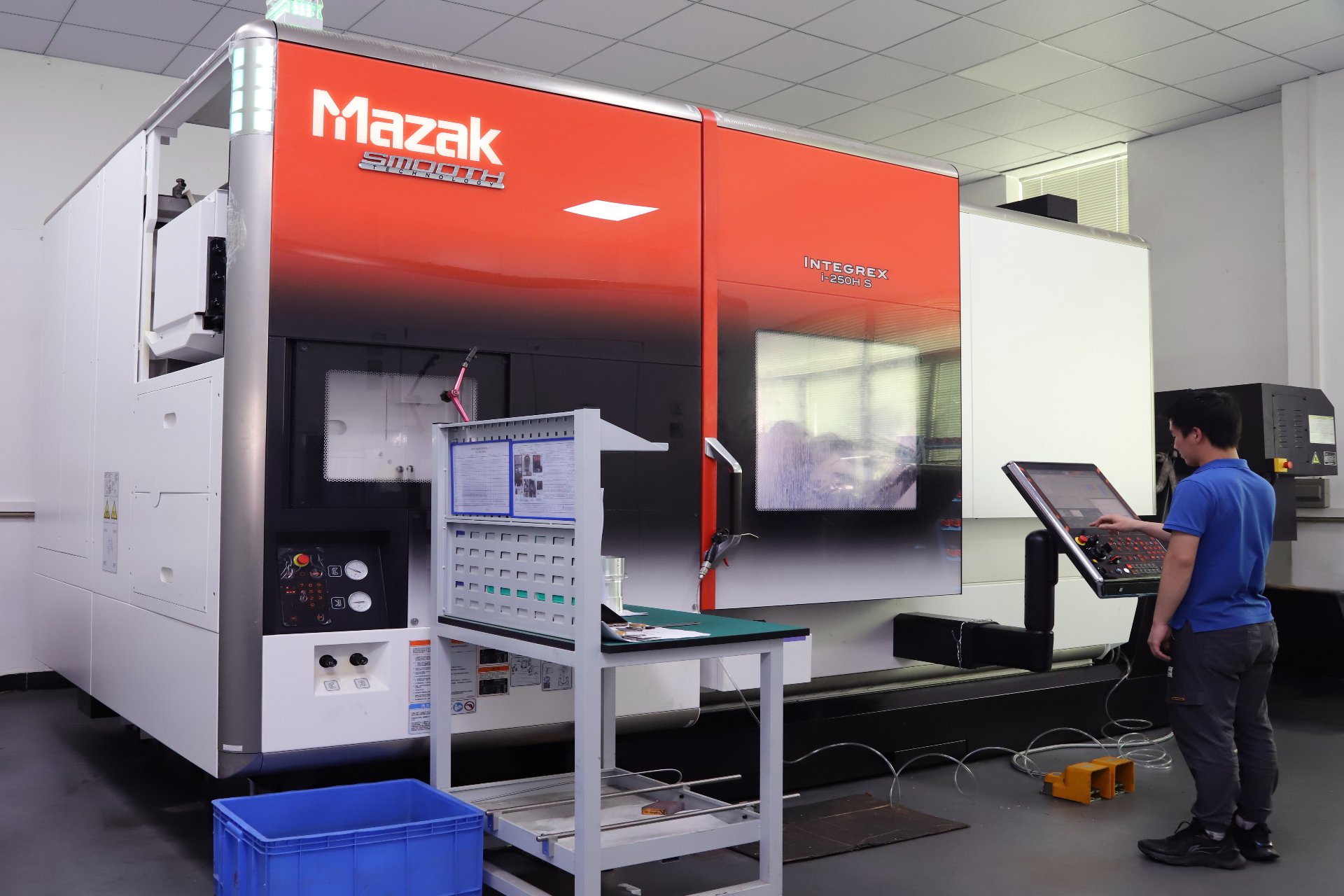
Then confirm the factory claim. Ask for the actual machine list with models and counts, request a live video walk-through of the floor, and check that the registration matches who you will pay. A real manufacturer answers all three without hesitation and films its own floor on demand; a trading desk dodges, delays, or recycles brochure footage. Verify the registration number independently where the registry is public, and confirm that the machines run under the entity you will pay. The factory page on this site shows the floor documentation a manufacturer can produce, which is the standard to request from any candidate.
Gate two: does the quality evidence actually verify?
The second gate separates certificates that prove something from logos that prove nothing. Ask for the certificates the supplier advertises — ISO 9001:2015 as the quality baseline, plus IATF 16949:2016 (product design excluded) and ISO 14001:2015 where relevant — with their certificate numbers, and check the numbers with the issuing registrar. A genuine certificate resolves to its issuer and scope; a number that does not resolve, or an image that changes between requests, is disqualifying on its own. A supplier that hands over numbers for you to verify is telling the truth; one that shows only logos is giving you something you cannot confirm.
Beyond the certificates, test how the quality system shows up on a lot. Ask what documents ship with the parts, how non-conformances are isolated to their lots, and how incoming material is verified against its certificate. Ask for a sample dimensional report and material record from a past lot, and read them: does the report show measured values against callouts, and does the material record tie a certificate to a real heat? The realistic capability claims for precision machining are ±0.003 mm in milling and turning and ±0.002 mm in grinding, with process capability at Cpk 1.67 or higher on key characteristics and Cpk ≥ 1.33 on general characteristics. Capability is reported per characteristic: every report names the feature, its tolerance band, the sample size, the sigma method, and the study window. — a supplier whose claims contradict that reality is describing something it cannot deliver. The quality page shows how one China-based shop structures its verification and reporting, which is a concrete benchmark for the evidence you request.
Gate three: is the quote a landed cost or a factory price?
The third gate is where China sourcing economics either work or silently fail. The price on a quote is not the price on your dock: duty is usually paid by the importer of record, freight sits with one side or the other depending on the incoterm, and customs can add time and cost at either end. Ask every candidate to quote on the same incoterm, and build your own landed-cost model that adds freight, duty, and insurance to each factory price before you compare. A quote priced Ex Works and a quote delivered to your dock are not comparable numbers, and comparing them is how the China price advantage evaporates on the first shipment.
Ask for the quote to split its drivers — material, machining, setup, and finishing — and ask what documents ship with the lot, because inspection reports and certificates are either inside the price or added later. Ask how the parts will ship and what the freight leg realistically adds to the schedule. A supplier that answers with a named incoterm, a real transit estimate, and a split quote is pricing the whole delivery; one that returns a lump sum and a promise is describing half the journey. Model the landed cost across a year of volume, not one order, and the geography decision becomes a real number instead of a hope.
Gate four: how are your drawings and your IP handled?
The fourth gate addresses the concern buyers raise most often and test least often: intellectual property. The test is procedural. Ask whether the supplier will sign an NDA before production data moves, and confirm the terms cover your drawings, tolerances, and process details, not just a general confidentiality line. A serious machining supplier treats an NDA as routine and expects one before full data moves. Then ask how sensitive files are stored once received: encrypted drives and access-controlled storage for digital files, and locked storage for paper, are the marks of a shop that takes confidentiality seriously.
Also ask what the supplier does with your data after the order. Files that are deleted or returned after a project, and process records that stay within the supplier's controlled system rather than circulating to every sales desk, are the behaviors that matter. The NDA is the legal floor; the storage and handling answers are the practical reality. Send only the files needed for quoting before the NDA is signed, then the full package after — a discipline that costs nothing and protects the part of your IP that has commercial value. A supplier that resists an NDA or stores files carelessly is telling you how your design would be treated if a dispute ever arose.
Gate five: what do the commercial terms say about who carries the risk?
The fifth gate reads the commercial terms as a signal of how the supplier expects the relationship to go. Payment structure is the clearest indicator. A deposit to start, with the balance tied to inspection results or shipment, keeps your leverage on your side across the distance — a shop confident in its output will agree to a balance against an approved inspection report. Full prepayment from an unproven supplier is a risk you would be funding, and pressure to pay outside normal terms is a red flag regardless of how convincing the sales conversation has been.
The order document is the second half of the gate. It should name the drawing revision and its issue date, the material grade and condition, the quantity, and the incoterm — a price without an incoterm is not a price, and a revision without a date is not a specification. Agree in writing what triggers a re-quote, typically any revision after the order is placed, and what the first-article approval step looks like. Payment terms that concentrate all risk on the buyer, and order documents that leave the commercial basis undefined, are not negotiation starting points — they are findings. The FAQs page covers the payment and commercial structure one China-based supplier offers, which is a useful baseline for comparing terms across candidates.
Which red flags should end the screening instantly?
Some findings are terminal, and naming them saves more time than any checklist. An entity that shifts between the quote and the invoice, or bank details in a name that does not match the registration, ends the search. Refusal to share certificate numbers, sample reports, or a video walk-through means the supplier cannot demonstrate what it claims. Quality promises beyond realistic machining capability — tighter than ±0.003 mm on a milled surface without a grinding operation, for example — describe something the shop cannot deliver. Reluctance to sign an NDA, or resistance to a payment balance tied to inspection, signals how a problem would be handled if one arose. Pressure to pay in full or to move quickly before verification is the oldest pattern in cross-border sourcing, and it is always a reason to slow down.
When several red flags appear together, end the conversation cleanly and move to the next candidate. The five gates have done their job, and the discipline of walking away from a bad candidate is what makes the good candidate's first article affordable. Keep the evidence you collected — the registration number, the certificate numbers, the quote with its incoterm — filed against each supplier, because that file becomes the baseline for the receiving check when the first order arrives.
One caution about the gate order: run them in sequence and resist the urge to skip ahead. The supplier with the persuasive sales video and the weak registration number is still a weak registration number at gate one, and no amount of impressive marketing after that point repairs the entity mismatch. The five gates are deliberately ordered from the cheapest and most disqualifying check to the richest — a supplier that fails early costs you minutes, while a failure discovered at the first-article stage costs you weeks. Let the order do that work for you, and the 30 minutes stay inside 30 minutes.
How do you run the first article that proves the choice?
When a supplier passes all five gates, the next step is not a production order — it is a first article ordered the way production will run. Order one part or a small batch, machined to your drawing with the full document set — material certificate, dimensional report, conformity statement — and ship it by courier rather than folding it into a sea-freight consolidation. Measure the critical dimensions on your own equipment and compare them to the report. Match the certificate numbers to the lots you received and the grade to your callout. Confirm the surface finish and the treatment class against the drawing.
The first article is the strongest single test of the whole chain: it proves the machining, the documentation, the packaging, and the shipping leg on one part you can verify yourself. If the part matches its paperwork, the supplier's system is real and volume is a scaling decision. If it drifts, the lesson has cost one part and one courier shipment instead of a production lot and a container. On the first production order, repeat the check on a sample of parts and hold the same standard — a lot whose paperwork does not match its parts is a lot to hold, and the documents make the hold defensible. The machined-parts guide shows what a quoted part contains, and the contact page is where a specific drawing becomes a specific screening conversation with the five gates answered up front.
Frequently Asked Questions
Can I vet a machined-in-China supplier without visiting?
Yes, to a useful depth. The entity can be checked against the registry, certificates against their registrars, capability against sample reports, and the quote against your landed-cost model. A first article by courier then proves the whole chain before volume moves.
How do I tell a real factory from a trading company?
Ask for the machine list with models and counts, request a live video walk-through of the floor, and match the business registration to the entity you pay. A real manufacturer answers all three without hesitation; a trading desk dodges or recycles brochure pages.
Which certificates should I check, and how?
ISO 9001:2015 as the quality baseline, plus IATF 16949:2016 (product design excluded) and ISO 14001:2015 where relevant. Take the certificate numbers and check them with the issuing registrar. A supplier that hands over numbers to verify is telling the truth; one that shows only logos is not.
Why does the incoterm matter when comparing China quotes?
Because the importer of record usually pays duty at clearance, and freight and insurance sit with one side or the other depending on the terms. Compare every quote on the same incoterm and include duty and freight in the landed cost, or you are comparing factory prices with delivered prices.
How do I protect my drawings and IP before sharing them?
Sign an NDA before full production data moves, and send only the files needed for quoting. Ask how the supplier stores sensitive files — encrypted drives and access-controlled storage are the marks of a shop that takes confidentiality seriously.
What payment terms keep risk on the right side?
A deposit to start with the balance tied to inspection results or shipment keeps your leverage across the distance. Full prepayment from an unproven supplier is risk you would be funding. A confident shop will agree to a balance against an approved inspection report.
What is the strongest single test of a new supplier?
A first article ordered the way production will run — one part or a small batch with the full document set, shipped by courier. Measure the critical dimensions yourself and match the certificate numbers. If the part matches its paperwork, the chain works.
Running the five gates and need a supplier that answers all of them up front?
Write to [email protected] or call +86 13126536955 — registration, certificate numbers, machine list, sample reports, and commercial terms are provided before any commitment.